Sleep Calculator
Pick your wake-up time, then tap Calculate to see your best bedtimes.
Adjust time to fall asleep
The science
Why the exact minute matters
Sleep isn’t one flat state. Your brain moves through a repeating 90-minute loop of lighter and deeper stages all night, and waking up mid-loop is what causes grogginess, even after a “full” night’s sleep.
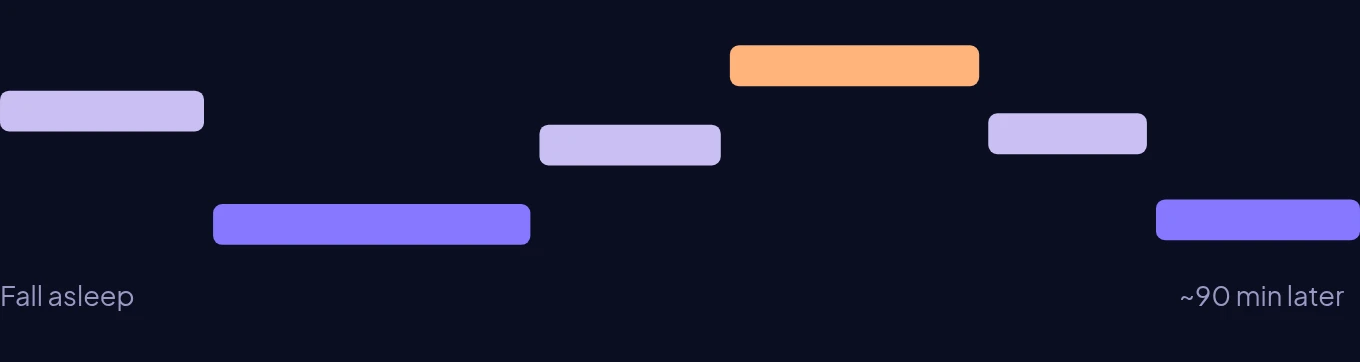
Light sleep
Deep sleep
REM sleep
1
You drift into light sleep
Breathing and heart rate slow. It’s still easy to wake up here with no grogginess at all.
2
You sink into deep sleep
The body repairs tissue and consolidates memory. Getting pulled out of this stage is what produces heavy, disoriented grogginess, a state called sleep inertia.
3
You surface through REM
Brain activity picks back up, dreaming happens, and the body rises back toward light sleep, the natural exit point from the cycle.
4
The loop repeats, ~5-6 times
A full night is several of these 90-minute loops back to back. This calculator times your alarm for the top of a loop, not the middle.
By age
How much sleep you actually need
Cycle count matters most, but the total hours you’re aiming for shifts a lot across a lifetime.
Newborn · 0–3mo
14–17 hrs
Toddler · 1–2yr
11–14 hrs
School age · 6–12yr
9–12 hrs
Teen · 13–18yr
8–10 hrs
Adult · 18–64yr
7–9 hrs
Older adult · 65+
7–8 hrs
Questions
Frequently asked
Is it bad if I wake up mid-cycle sometimes?
No, it happens to everyone occasionally, and it’s not harmful on its own. It just tends to feel worse in the moment (grogginess, slower reaction time) than waking at a natural break point, even with the same total sleep time.
What if I can’t fall asleep in 15 minutes?
Use the “Adjust time to fall asleep” slider above the results. If it regularly takes you much longer, that’s also worth mentioning to a doctor, since chronic difficulty falling asleep can have treatable causes.
Is 6 hours of sleep ever enough?
Six hours lands you at exactly 4 complete cycles, which this tool will show you. Most adults need 5 to 6 cycles (7.5 to 9 hours) for full physical and cognitive recovery, so four cycles is a workable minimum, not a target.
How accurate is the 90-minute number?
90 minutes is a well-established average across sleep research, but individual cycles can run shorter or longer. Treat the results as a strong starting point, then nudge your bedtime earlier or later by 15 minutes if you notice a pattern.
What’s the best number of cycles to aim for?
5 to 6 cycles (7.5 to 9 hours) is the sweet spot for most adults, enough for several full rounds of deep and REM sleep. 4 cycles (6 hours) is a usable floor on a bad night, but shouldn’t be the regular target.
Why do I still feel tired after a full 8 hours?
Usually it’s timing, not quantity. 8 hours doesn’t divide evenly into 90-minute cycles, so your alarm may be landing you mid-cycle. It can also point to poor sleep quality (frequent waking, a late caffeine or screen habit) rather than too little sleep overall.
Does napping follow the same cycle rule?
Yes, with a twist: a short 20-minute nap deliberately stays in light sleep so you wake up quickly and clear-headed. A nap long enough to reach deep sleep (closer to a full 90-minute cycle) will leave you groggy if you cut it short.